$90 Medicare Rebate vs. Medicare Advantage OTC Benefits: What New Yorkers Should Know
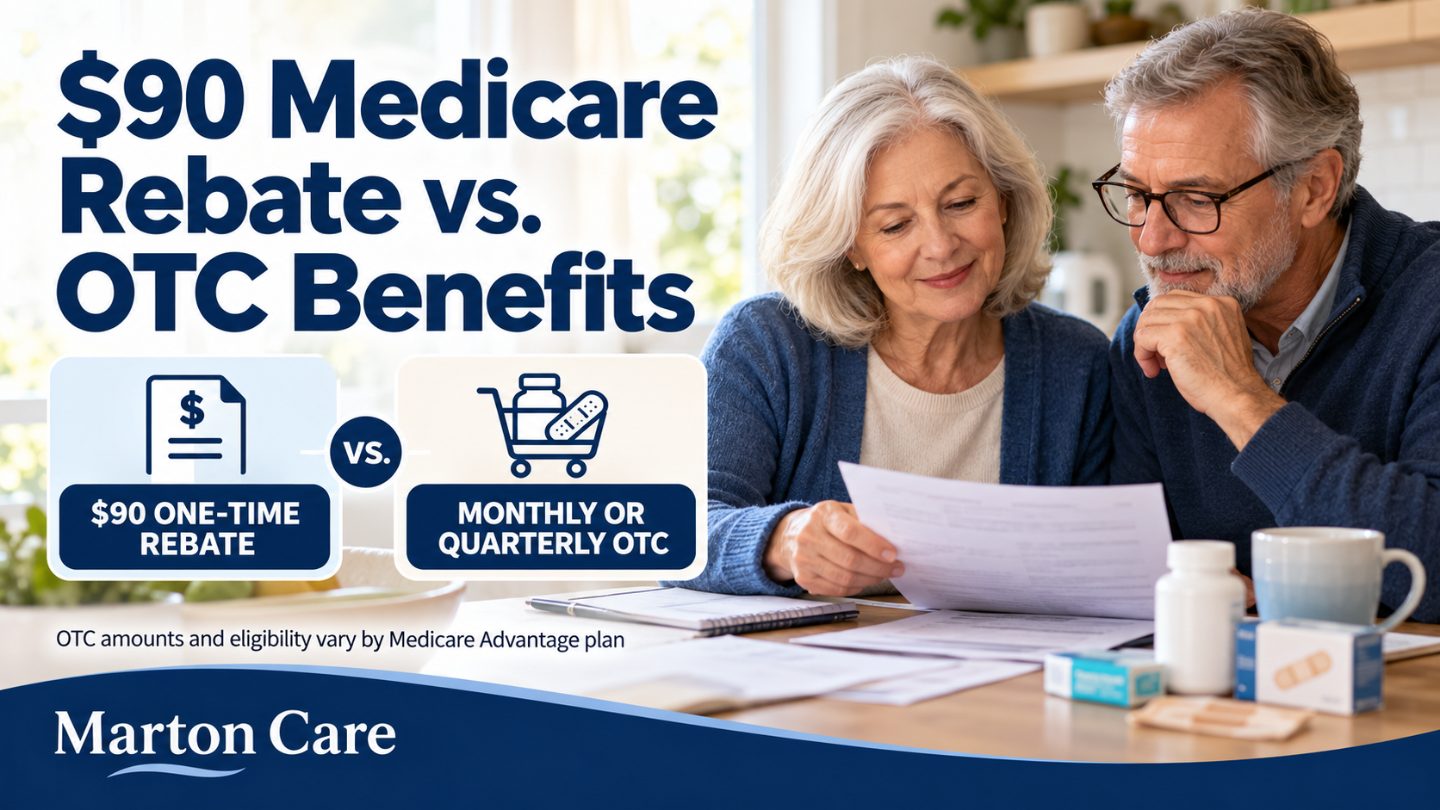
Approximately 20.8 million eligible Original Medicare beneficiaries will receive a one-time $90 payment in October 2026, according to the Centers for Medicare & Medicaid Services (CMS). The rebate is intended to help offset Medicare Part B premiums.
Medicare Advantage members are excluded from this payment. However, some Medicare Advantage plans offer recurring allowances for eligible over-the-counter health products, commonly called OTC benefits. These allowances may provide hundreds of dollars in eligible purchases over a year, depending on the plan.
The important distinction: the $90 rebate is a direct payment, while an OTC allowance is restricted to covered purchases.
How much do Medicare premiums generally cost?
In 2026, the standard Medicare Part B premium is $202.90 per month, or $2,434.80 for a full year. Higher-income beneficiaries pay more, and enrollment penalties can also increase the amount.
Most people pay no Part A premium because they or a spouse paid Medicare taxes long enough while working. People who must purchase Part A generally pay $311 or $565 monthly.
Prescription-drug coverage through Part D and supplemental insurance through Medigap have separate premiums that vary.
Medicare Advantage premiums also vary. Even when a plan advertises a $0 additional plan premium, members generally must continue paying their Part B premium unless assistance or a plan benefit reduces what they personally pay.
Read Medicare’s official cost guide.
How much does the $90 rebate help?
The one-time payment offsets approximately:
44% of one month’s standard Part B premium.
3.7% of a full year’s standard Part B premiums.
For an eligible person paying $202.90 monthly, October’s effective premium expense would be $112.90 after accounting for the separate $90 payment.
The official premium remains $202.90. This payment does not permanently lower the premium or repeat every month.
Who qualifies?
CMS identifies recipients as certain beneficiaries enrolled in Original Medicare Part B who live in the United States.
CMS lists these exclusions:
Medicare Advantage enrollment.
Medicaid assistance paying Medicare premiums.
Income-related premium surcharges, known as IRMAA.
A Medicare card alone does not establish eligibility. CMS’s FAQ uses “or” between some premium-related conditions, creating ambiguity. If your circumstances are unclear, call 1-800-MEDICARE (1-800-633-4227) for an individual determination.
When will payments arrive?
CMS says most eligible recipients should receive a direct deposit on or around October 8, 2026.
Those without direct deposit are expected to receive a Treasury check later in October at the mailing address registered with Medicare. CMS describes an automatic process and does not list a separate application requirement.
An explanatory email or letter is expected in mid-October.
Read the official CMS rebate FAQ.
Where does the funding come from?
The White House says the payments draw on approximately $2 billion Congress made available to the Medicare Improvement Fund. Congress established the fund in 2008 to support improvements to Original Medicare.
Using CMS’s announced recipient count:
20.8 million people × $90 = approximately $1.872 billion in direct payments.
This is a calculation from the published figures, not an official accounting of total program expenses. The cited announcements do not explain how any remaining balance would be allocated.
The rebate is a flat payment toward premiums. It is not calculated from a beneficiary’s medical bills or the number of services they used.
Read the White House funding announcement.
What is a Medicare Advantage OTC allowance?
An OTC allowance provides a set amount to purchase eligible nonprescription health and wellness products.
Depending on the plan, members may use a benefit card, an approved catalog, participating stores or another designated ordering system. Eligible items can include vitamins, pain relievers and first-aid supplies. The plan determines which products qualify.
There is no single monthly OTC amount that everyone receives by joining Medicare Advantage.
Some plans provide a monthly allowance, others provide a quarterly allowance, and some do not include an OTC allowance. Read Humana’s explanation of OTC benefits.
How much can monthly OTC benefits be worth?
The exact amount must be checked in the specific plan’s Summary of Benefits or Evidence of Coverage.
The following examples show how recurring allowances add up:
Illustrative monthly allowance Purchasing value over 12 months
$25 monthly $300 annually $50 monthly $600 annually $75 monthly $900 annually $100 monthly $1,200 annually
These are arithmetic examples, not a national average or a promise of benefits available in your ZIP code. They assume enrollment and eligibility for all 12 months and full use of the allowance under the plan’s rules.
For example, a $50 monthly OTC allowance could provide $600 in eligible purchases over a year. That exceeds a one-time $90 payment in purchasing value, but it cannot be treated as $600 in unrestricted cash.
What if the allowance is quarterly?
A quarterly benefit is made available once every three months.
For a documented 2026 example, Humana LCMC Advantage H1951-051 (HMO) lists a $120 quarterly OTC allowance. That equals:
$480 annually.
A $40 monthly equivalent for comparison.
The monthly equivalent does not mean the plan deposits $40 each month. This is also a specific plan example, not a claim that the plan is available in New York.
Read the plan’s 2026 Summary of Benefits.
Are food and utility allowances the same as OTC benefits?
Not necessarily. Some plans offer a combined credit that covers OTC products and other eligible expenses.
For example, the 2026 UHC Dual Complete GA-V1 (PPO D-SNP) lists a $65 monthly credit for OTC products, plus healthy food and utilities for qualifying members.
That credit totals $780 over 12 months for someone eligible and enrolled all year. It is a shared credit—not separate $65 allowances for OTC, food and utilities.
The plan says food and utility benefits require qualifying chronic conditions and other coverage criteria. Enrollment alone therefore does not necessarily unlock every spending category.
This is a Georgia plan example, not a benefit promised to New Yorkers.
Read the UnitedHealthcare plan benefit details.
What should New Yorkers check before expecting an allowance?
Before enrolling or budgeting around a benefit, ask:
How much does my exact plan provide?
Is the allowance monthly or quarterly?
Is it OTC-only or shared with other spending categories?
Which products and stores are eligible?
Does unused money expire or roll over?
Do food or utility benefits require additional eligibility?
Are my doctors, hospitals and prescriptions covered?
For a D-SNP or a plan connected with New York’s MAP coverage, confirm the amount in that plan’s own benefit documents. Another plan’s advertised allowance does not establish what you will receive.
Is the average $222 in Medicare Advantage funding an OTC allowance?
No.
KFF, citing MedPAC, reports that Medicare Advantage plans receive an average of $2,664 per enrollee annually in additional funding above their estimated costs of providing Medicare-covered services in 2026—equivalent to $222 monthly.
That funding supports supplemental benefits and lower member costs across several categories. It is not a $222 monthly OTC allowance, a guaranteed cash payment or an amount every member can spend.
Read KFF’s 2026 Medicare Advantage benefit analysis.
How do these amounts compare?
Payment or benefit Amount What it represents
Original Medicare rebate $90 once Direct payment to eligible beneficiaries Illustrative monthly OTC benefit $50 monthly / $600 annually Restricted purchasing allowance, if the plan offers it Documented quarterly OTC example $120 quarterly / $480 annually Eligible OTC purchases through one specific plan Average additional MA funding $2,664 annually Funding paid to plans for benefits and lower costs—not a member spending allowance
A recurring OTC benefit may provide more annual purchasing value than $90. However, the value depends on eligibility, covered products and how much of the allowance a member actually uses.
Medicare Advantage members are excluded from the $90 rebate. That does not establish that every MA member receives OTC benefits, or that supplemental benefits were the government’s official reason for the exclusion.
Choosing coverage requires more than comparing allowances
An OTC allowance can help with everyday healthcare expenses. It should be considered alongside premiums, copayments, prescription coverage, provider access and authorization requirements.
A larger allowance may not provide the best overall value if the plan creates higher costs or limits access to needed care.
For rebate eligibility questions, call 1-800-MEDICARE (1-800-633-4227).
For payment-status questions, CMS directs beneficiaries to call Social Security at 1-800-772-1213 beginning October 15, 2026.
This article provides general information. Plan examples illustrate benefit structures and do not establish availability in New York. Actual eligibility, benefits and costs depend on your coverage and circumstances.