Silver in Medicine: Ancient Remedies, Modern Uses, and Persistent Myths
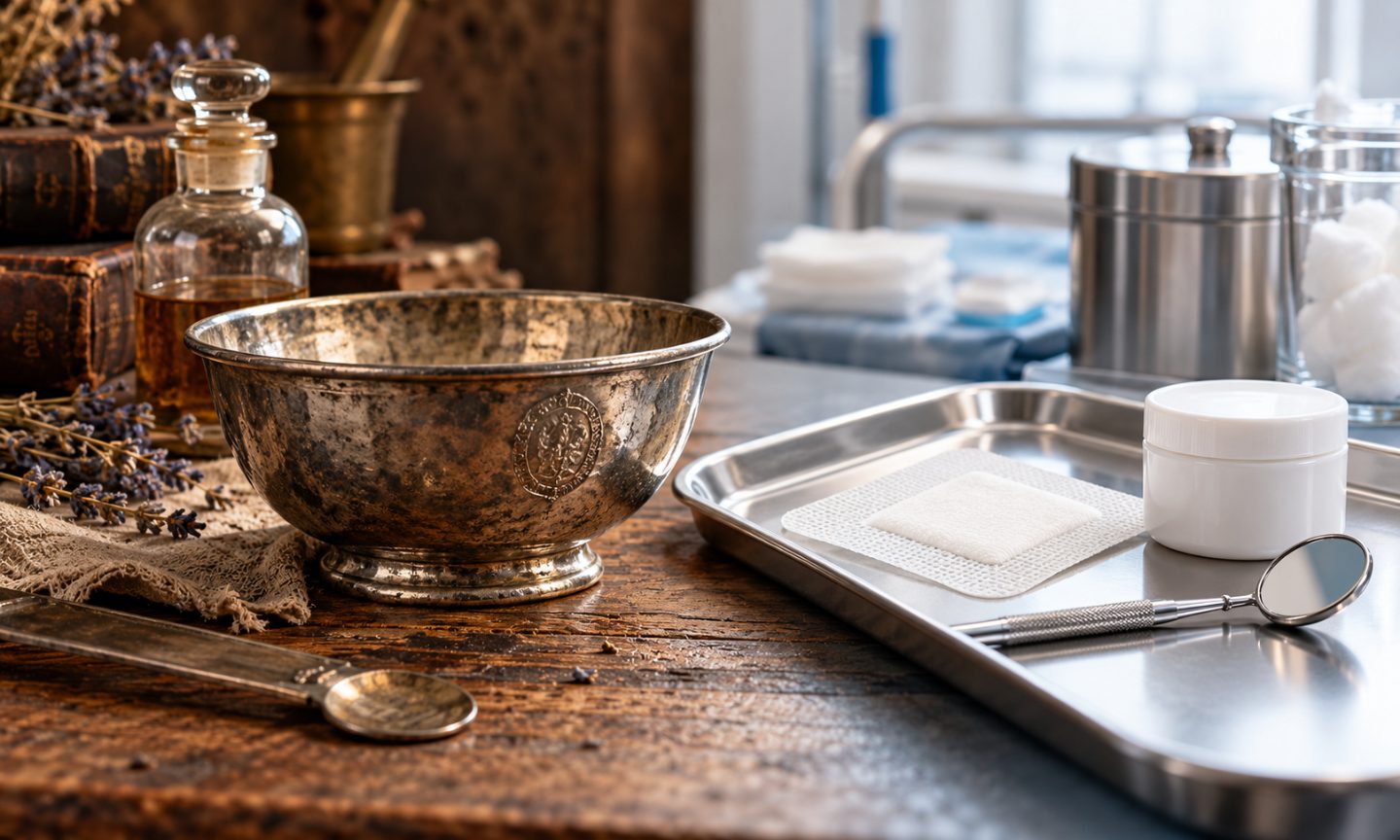
Silver has been part of medicine for centuries. It helped physicians fight infection before modern antibiotics and remains an ingredient in certain burn creams, wound dressings, and dental treatments.
That history also helps explain its enduring appeal as an alternative remedy. Products marketed as colloidal silver often borrow credibility from silver’s medical uses, even when the product, method of use, and claimed benefits are very different.
Understanding silver in medicine requires asking a specific question: Which silver product, used in which way, for which condition? Evidence for a dressing applied to a wound cannot establish that drinking silver treats an infection elsewhere in the body.
How silver was used in earlier times
Historical accounts describe ancient societies using silver vessels to store food or liquids and silver preparations for medicinal purposes. These practices developed long before people understood bacteria or could conduct controlled clinical trials. A published history of silver’s medical use documents its longstanding role before antibiotics entered clinical practice in the 1940s.
Early observations sometimes pointed toward useful applications. However, historical use alone cannot establish that a treatment was effective, that its benefits outweighed its harms, or that every later product bearing the same ingredient would work.
One well-documented milestone came in 1881, when German obstetrician Carl Credé published his work on silver nitrate drops to prevent serious eye infections in newborns. This became an important approach to preventing infection-related blindness, as described in a World Health Organization historical account.
Medical practice has since changed. The CDC explains that U.S. hospitals historically used silver nitrate for newborn eye prophylaxis and now generally use erythromycin. A treatment’s important historical role does not establish that it remains today’s preferred option.
As modern antibiotics became available, much of silver’s earlier role in treating infections was displaced. Its more targeted local applications continued to develop.
Why silver can affect microbes
Certain silver products release silver ions—electrically charged silver atoms. These can interfere with microbial structures and processes, including cell walls and growth. In wound dressings, moisture helps make these ions available, according to NHS silver-dressing guidance.
But antimicrobial activity is only one part of a useful treatment. A product must also reach the intended site, be tolerable to human tissue, and improve outcomes that matter to patients.
Killing microbes in a laboratory is an early finding. Demonstrating that a product safely heals wounds or treats disease in people requires clinical evidence.
Where silver is used in medicine today
Silver sulfadiazine cream for selected burns
Silver sulfadiazine, known by the brand name Silvadene and other names, is a prescription topical antimicrobial. Its U.S. prescribing information identifies its role as an additional treatment to prevent and treat wound infection in patients with second- and third-degree burns.
It remains a recognizable burn-care medicine, but that indication does not make it the best choice for every burn.
For example, a small randomized trial in adults with limited superficial partial-thickness burns found that petrolatum gel could be at least as effective as silver sulfadiazine with gauze for healing, with no wound infections observed in either group. The study was small, and its results do not establish how to treat extensive or deep burns.
A medicine can have a legitimate use while simpler care or a different dressing is preferable in another situation. A burn clinician considers depth, extent, infection concerns, comfort, and dressing needs.
Silver-containing wound dressings
Silver is incorporated into some foams, fibers, and other dressings used in wound care. Clinicians may select them for a limited period when local infection is a concern.
The evidence varies by wound type and product. Silver’s antimicrobial properties do not establish that every silver dressing speeds healing or outperforms an appropriate dressing without silver.
An international consensus on silver dressings recommends an initial period of about two weeks followed by reassessment. If infection signs have resolved, continued topical antimicrobial treatment may no longer be needed. If the wound is not improving, the diagnosis and treatment plan need review.
That two-week reassessment is a clinical decision point, not permission to self-treat an unexplained wound for two weeks. The dressing should have a defined purpose and a plan for review.
Silver nitrate for cauterization
Silver nitrate has an established procedural role. Clinicians can apply it precisely to chemically cauterize tissue, helping control certain small bleeding sites or reduce excessive granulation tissue.
Examples include sealing a visible bleeding point during treatment for some nosebleeds and treating granulomas around a stoma.
Here, the intended effect includes controlled tissue destruction. Contact with surrounding healthy tissue can cause chemical burns, and local dark staining can occur. Silver nitrate therefore requires careful application for a specific reason.
Silver diamine fluoride for tooth decay
Silver diamine fluoride, often abbreviated SDF, is a liquid applied to selected dental cavities to help stop decay from progressing.
In interim results from an NIH-funded randomized trial reported in 2024, 54% of treated cavities stopped progressing after a single SDF application, compared with 21% after placebo, at six months. The children in that analysis were ages one through five and had severe early childhood tooth decay. Not every cavity responded.
The American Academy of Pediatric Dentistry’s chairside guide identifies situations where SDF may be helpful, including difficulty tolerating restorative treatment or accessing dental care.
There is an important tradeoff: treated decay usually turns permanently black. Repeat applications and dental follow-up may be necessary. SDF also does not rebuild the missing shape of a damaged tooth; a dentist may still recommend a restoration.
Five common myths about silver-based medicine
Myth 1: “Silver worked in ancient times, so every silver remedy works today.”
Historical use can help researchers identify promising treatments. It cannot replace testing of the actual formulation, dose, route, and condition. Ancient storage practices and a modern dental treatment do not validate a bottle marketed for general health.
Myth 2: “If hospitals use silver, drinking colloidal silver must be beneficial.”
A wound dressing and an oral supplement expose the body differently. The National Center for Complementary and Integrative Health reports no known bodily benefit from taking silver by mouth. Silver is not an essential nutrient.
Myth 3: “Natural products cannot cause lasting harm.”
Colloidal silver can accumulate in tissues and cause argyria: blue-gray skin discoloration that is usually permanent. It can interfere with the absorption of certain antibiotics and thyroid medication. NCCIH also notes evidence of possible kidney, liver, or nervous-system problems.
Myth 4: “A dressing with silver always heals a wound faster.”
A wound may need protection and moisture management without an antimicrobial ingredient. NICE guidance on chronic wounds advises against routine silver use for uncomplicated ulcers. An added ingredient should address a clinical need.
Myth 5: “A blue-gray skin change means the product is detoxifying the body.”
Argyria reflects silver deposition in tissue. It is an adverse effect, not evidence that an infection is clearing or that a treatment is working. Local staining after a dental or cautery procedure involves a different exposure pattern and should be explained by the treating clinician.
When another treatment is preferred
Silver should be chosen for a defined indication. These are important situations in which routine silver treatment is inappropriate or another approach deserves priority:
Situation Why silver may be unsuitable
A clean, uncomplicated wound An appropriate dressing without silver may meet the wound’s needs. Routine antimicrobial treatment adds no established benefit for every healing wound. A pressure injury Silver is not a substitute for pressure relief and a complete wound-care plan. NICE advises against routinely applying topical antimicrobials to adult pressure ulcers. A diabetes-related foot infection The IWGDF/IDSA guideline suggests against silver preparations for treating these infections. Assessment, appropriate antibiotics when indicated, wound care, circulation, and pressure relief take priority. A minor superficial burn Silver sulfadiazine is not automatically preferable. Treatment depends on the burn, and simpler care or another dressing may be suitable. A cavity with signs of irreversible pulp inflammation SDF is inadequate for this problem. The patient needs dental assessment and treatment directed at the affected tooth. A proposed oral remedy for general health or infection Colloidal silver has no established safe and effective role for treating disease by mouth.
These distinctions are reflected in NICE pressure-ulcer recommendations, the IWGDF/IDSA diabetic-foot infection guideline, and American Academy of Pediatrics guidance on SDF.
There are also product-specific precautions. Silver sulfadiazine should not be used in premature infants, infants younger than two months, or pregnant patients approaching delivery. Its labeling identifies allergy concerns and cautions involving G6PD deficiency and impaired kidney or liver function. Extensive burn treatment may require monitoring because absorption can increase.
These restrictions belong to that particular medicine. They should not be applied indiscriminately to every product containing silver. Conversely, tolerating one silver product does not establish that another is appropriate.
How to make an informed choice
Before starting a silver-containing treatment, patients and caregivers can ask:
- What problem is this product intended to treat?
- What evidence supports it for this particular condition?
- Would an option without silver work as well?
- What side effects or staining should we expect?
- When will treatment be reviewed, changed, or stopped?
For home-care patients with persistent wounds, choosing a dressing is only one part of treatment. Pressure, circulation, blood-sugar control, and other underlying problems may determine whether healing occurs.
Silver’s medical history deserves recognition. Its present-day use deserves the same careful assessment as any other treatment: a clear purpose, evidence of benefit, attention to harms, and follow-up.
This article provides general health information and does not replace individualized medical or dental advice.