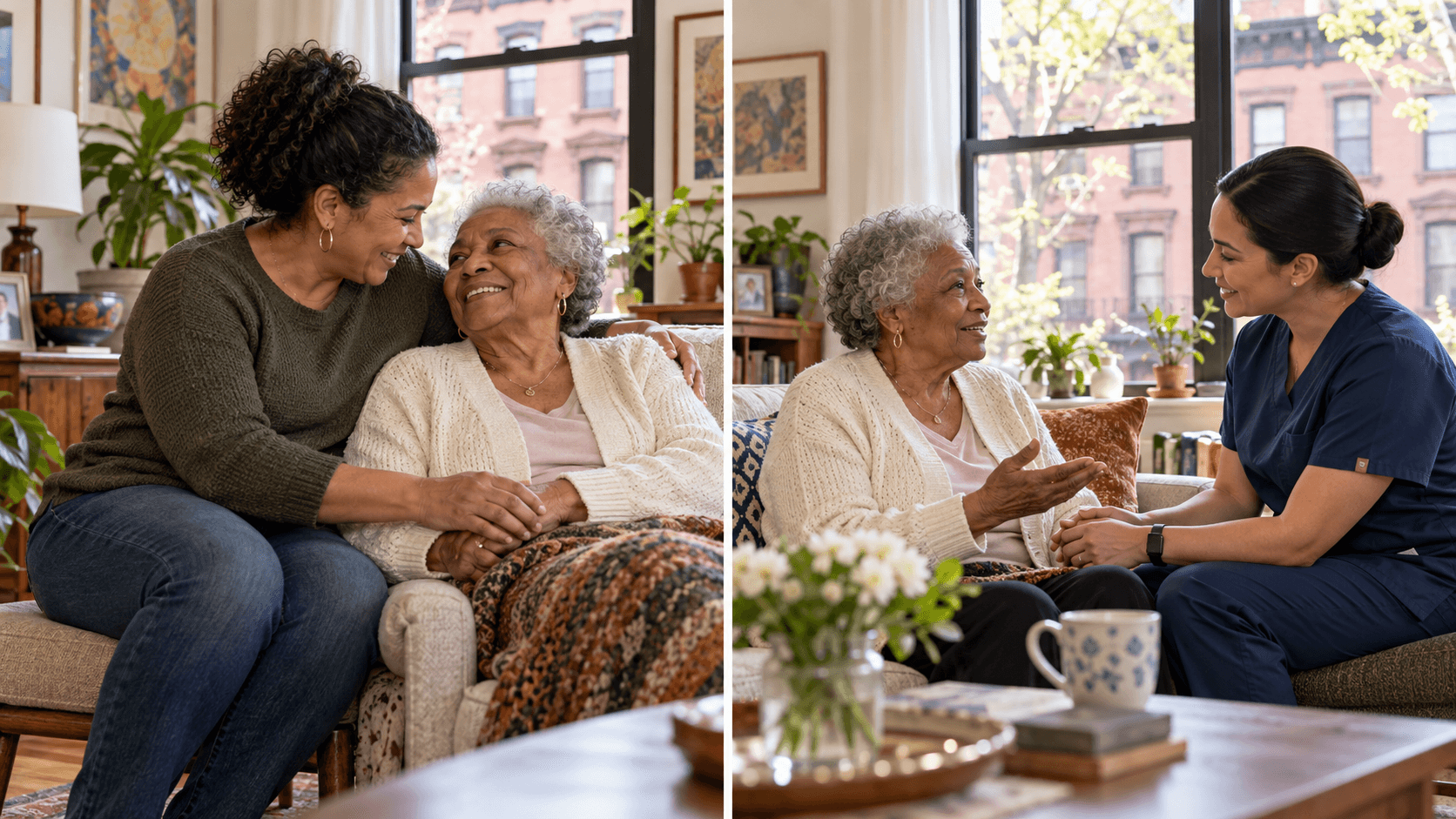
What Does a Home Care Aide Actually Help With?

When a loved one needs help at home, “get an aide” can sound like a simple solution. But what does an aide actually do? Can they help someone bathe and get dressed? Prepare meals? Give medications? Perform a task that would usually require a nurse?
The answer depends on the person’s needs, the type of aide or care program, and the authorized care plan. In New York, personal care aides, home health aides, nurses, and CDPAP personal assistants have different roles. Understanding those roles helps families choose care that fits.
Help with bathing, dressing, and other personal needs
For many people, the most valuable help is also the most personal. Depending on the care plan, an aide may assist with:
- Bathing or showering
- Dressing and undressing
- Grooming and oral hygiene
- Using the toilet
- Getting in or out of bed or a chair
- Walking around the home
- Eating when physical assistance is needed
The amount of help varies. One person may need an aide to perform most of a task; another may need assistance with only one step. The aim is to support safety and dignity while allowing the person to do what they still can independently. New York includes activities such as bathing, toileting, grooming, and meal preparation in its description of personal care services.
Help with meals and everyday routines
A care plan may also include preparing meals, grocery shopping, and light housekeeping related to the person’s needs. An aide might make breakfast, clean up after a meal, change bed linens, or help keep frequently used areas orderly. New York’s caregiver guide lists these among the ways personal care aides may help.
These services are tied to the individual receiving care. An aide is not automatically responsible for every household chore or errands for the whole family. The agency or health plan should explain which tasks are included in the person’s care plan.
Help with movement and daily safety
Getting from a bed to a chair or walking to the bathroom can become difficult after an illness, injury, or gradual decline. An aide may assist with these movements according to the person’s care plan and the aide’s training.
An aide may also notice a change in the person’s usual condition, such as new difficulty walking, eating less, or appearing more confused. Those observations should be reported to the appropriate supervisor or care team. The aide does not diagnose the cause of a medical change.
What is the difference between a personal care aide and a home health aide?
Both may help with daily activities, but their training, assigned duties, and supervision can differ. A personal care aide (PCA) primarily helps with personal care and everyday tasks. A home health aide (HHA) may perform assigned home health tasks under the required supervision of a registered nurse or therapist. Neither title means the worker is a nurse.
The safest approach is to ask the agency what the specific worker is trained to do and what the written care plan assigns to them. Do not assume that an aide can perform a clinical procedure simply because the person needs it.
CDPAP offers a different kind of flexibility
New York’s Consumer Directed Personal Assistance Program (CDPAP) allows an eligible Medicaid member to choose and hire a personal assistant. The worker may be a friend or qualifying family member. The person receiving care—or a designated representative acting on their behalf—takes responsibility for directing the care, including training, scheduling, and supervising the assistant.
A CDPAP personal assistant’s role can go beyond the usual duties of a traditional aide. New York’s rules allow a consumer-directed assistant to perform personal care services, home health aide services, and skilled nursing tasks under the instruction, supervision, and direction of the consumer or designated representative. The state explains that CDPAP services may include services normally provided by a personal care aide, home health aide, or nurse.
Examples in state guidance include wound care, medication administration, injections, and catheterization. These are more complex tasks than families ordinarily expect from a traditional home care aide. For a CDPAP worker to perform a task, it must be part of the person’s assessed and authorized care, and the consumer or designated representative must ensure the worker is trained and performs it competently and safely.
That flexibility can be valuable when a person has a trusted caregiver who can learn their routine and provide both everyday and more complex assistance. It does not mean every CDPAP worker can perform every medical task automatically. Families should confirm the authorization, the care plan, and how each task will be taught and directed.
Where does a nurse fit in?
A nurse has a separate clinical role. The person receiving care may need nursing assessment, treatment, or other skilled services in addition to aide support. A CDPAP assistant’s ability to perform an authorized skilled task does not turn that assistant into a licensed nurse or eliminate every reason to involve one.
If someone comes home from a hospital with a new wound, medication regimen, or medical device, ask the discharge team and health plan to identify who is responsible for each part of the care. That conversation should happen before the person is left at home relying on an aide or family member to figure it out.
Does Medicare or Medicaid pay for an aide?
Coverage depends on the program and the person’s eligibility. New York Medicaid may authorize personal care or CDPAP services after an assessment and review of the person’s needs. Medicare’s home health benefit follows different rules: qualifying home health aide care is generally part-time or intermittent and connected to an eligible need for skilled home health services. Medicare generally does not pay for ongoing personal care when that is the only service a person needs.
Neither program guarantees a particular aide schedule based solely on a diagnosis. The services and hours must be determined for the individual.
Start with a picture of the whole day
If you are arranging care for a loved one, write down what happens from morning to night. Where do they need hands-on help? What can they do independently? Are there medications or procedures that require special planning? What happens when their usual caregiver is unavailable?
Bring that information to the assessment and review the resulting care plan. Ask exactly which tasks are authorized, who may perform them, when help will be available, and whom to contact if the person’s needs change.
Good home care is practical and personal. It might mean helping someone get dressed, preparing a familiar meal, or assisting with a more complex task through an appropriately directed CDPAP arrangement. The right plan begins with understanding what the person actually needs to live safely at home.
This article provides general information. Duties, CDPAP eligibility, authorization, and insurance coverage depend on the individual’s circumstances and current New York rules.