New York’s Home Care Worker ID Requirement Takes Effect: What Agencies and Medicaid Plans Need to Know
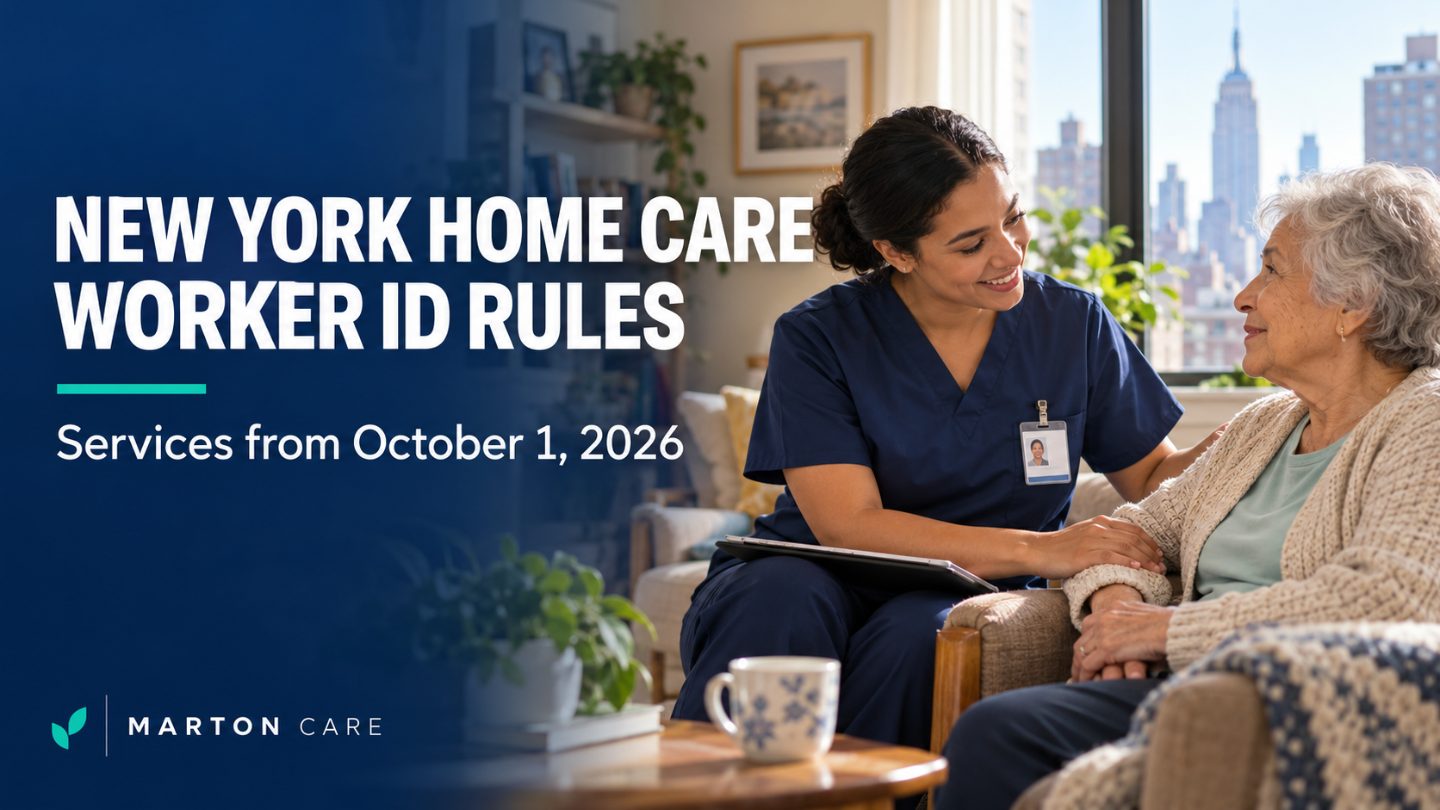
New York’s home care worker identification requirement is now in effect for covered Medicaid managed care home health aide, personal care, and Consumer Directed Personal Assistance Services (CDPAS) encounters with dates of service on or after October 1, 2026.
The New York State Department of Health’s Office of Health Insurance Programs requires health plans to report information identifying the individual worker who delivered these services. Home care agencies, the CDPAP Statewide Fiscal Intermediary, billing vendors, and clearinghouses need to supply and process that information correctly.
The state’s September 17, 2026 updated FAQ clarifies the requirements, corrects an earlier electronic billing instruction, and establishes a separate January 1, 2027 start date for the encounter completeness penalty.
Which health plans and providers are covered?
The updated FAQ identifies the following program lines:
- Mainstream Medicaid Managed Care.
- HIV Special Needs Plans.
- Health and Recovery Plans, known as HARPs.
- Medicaid Advantage Plus, known as MAP.
- Medicaid Managed Long Term Care Partial Capitation Plans, or MLTCP.
- Programs of All-Inclusive Care for the Elderly, known as PACE.
The guidance applies to managed care organizations, Licensed Home Care Services Agencies (LHCSAs), Certified Home Health Agencies (CHHAs), and the Consumer Directed Personal Assistance Program (CDPAP) Statewide Fiscal Intermediary.
The covered services are home health aide, personal care, and CDPAS. The requirement applies to both electronic and paper claims.
A claim and an encounter serve different purposes
A provider submits a claim to a health plan for payment. The plan reports an encounter record to the state describing the service delivered.
The state’s requirement concerns the worker information included in those encounter records. To fulfill it, plans must work with their contracted providers to obtain accurate worker information through the billing process.
For an agency, that means the billing record must identify the actual direct care worker in the fields specified by the guidance. Reporting the agency’s name and billing provider number alone does not identify the worker who performed the service.
What this means for aides, CDPAP caregivers, and visit information
For caregivers, the change creates a clearer connection between their identity and the covered Medicaid services billed under their name. This includes home health aides, personal care aides, and CDPAP caregivers, also called personal assistants.
Health plans will receive the worker information through claims, and the state will receive it through the plans’ encounter submissions.
For CDPAP services, the Statewide Fiscal Intermediary supplies the caregiver’s SFI Personal Assistant ID when an individual NPI is unavailable. If the worker already has an NPI, the updated state FAQ directs use of that individual Type 1 NPI. CDPAP personal assistants are therefore included in the worker identification reported on covered CDPAS claims and encounters.
New York already collects Electronic Visit Verification, or EVV, data through its eMedNY aggregator. EVV records contain caregiver, member, service, and visit information. The state’s technical guide explains that the existing Caregiver ID is assigned within the EVV system; it is not necessarily the Home Care Registry ID now being included in claims and encounters.
Adding the applicable worker identifier to the billing record gives plans and the state a more consistent way to identify who delivered each reported service. Once those records are successfully submitted, they can obtain that worker identification through routine reporting, without first requesting a separate worker-identification record from the provider.
The practical implication is greater visibility into a caregiver’s reported work. Where the relevant EVV and billing records are available and can be matched, this can support reviews of service dates, billed units, visit times, and possible overlapping or inconsistent service records.
This does not mean every health plan automatically receives the state’s entire EVV database, or that the new claim format contains every detail of every visit. EVV remains a separate source of visit information. eMedNY’s August 2026 technical guide also says that EVV records are not matched to claims as part of initial adjudication at that time.
Caregivers should make sure their name and worker ID are correct and promptly report inaccurate visit records to their agency or fiscal intermediary. Accurate records help protect both workers and the members they serve.
October 1 and January 1 are separate milestones
Date What the updated state guidance says
October 1, 2026 Worker information should be reported for covered services with dates of service on or after this date. January 1, 2027 The encounter completeness penalty goes into effect.
The January penalty date does not move the October service-date requirement. Providers should already be capturing the required worker information for October services.
The FAQ’s penalty statement concerns encounter completeness. Agencies should confirm each health plan’s claim acceptance, correction, and submission procedures directly with that plan.
Which worker ID should be used?
Direct care workers are not required to obtain a National Provider Identifier, or NPI, under this guidance.
If the worker already has an NPI, the updated FAQ directs plans to use it. It must be a Type 1 NPI identifying the individual, rather than a Type 2 NPI identifying an organization.
When an individual worker does not have an NPI, the applicable identifiers are:
Service and provider Worker identifier
Home health aide or personal care services through an LHCSA or CHHA Home Care Registry ID CDPAS through the Statewide Fiscal Intermediary SFI Personal Assistant ID
The agency’s billing provider NPI continues to be reported in the billing provider fields. The state says those billing provider segments are unchanged.
Providers must also supply the worker’s actual name. The updated FAQ expressly says a generic name cannot be used when the implementation guide requires the worker’s name alongside the ID.
The September update corrects an electronic billing instruction
Billing teams should check their systems against the September 17 update, particularly when more than one worker delivers services within a 24-hour period.
For non-NPI worker IDs, the guidance specifies G2 in REF01 and the worker ID in REF02, using these locations:
Electronic submission Same worker on all lines Multiple workers within a 24-hour period
Institutional, 837I Attending provider loop 2310A REF02 at the header Operating provider loop 2420A REF02 on the applicable separate lines Professional, 837P Rendering provider loop 2310B REF02 at the header Rendering provider loop 2420A REF02 on the applicable separate lines
For professional submissions, worker IDs at the line level identify workers different from the one reported at the header.
The updated guidance specifically corrects the earlier institutional instruction that listed 2420C for multiple workers. The September update directs those institutional line-level worker IDs to 2420A.
For institutional submissions with one worker, it specifies the attending provider loop 2310A, rather than the rendering provider loop 2310D.
Agencies and vendors relying on earlier instructions should review these corrections with the plan and clearinghouse.
Multiple workers may require modifier 77
For institutional and professional submissions, the updated guidance directs providers to use modifier 77 when the same procedure code appears on service lines performed by different direct care workers.
This helps distinguish the services as separate, rather than duplicative.
For example, when two aides provide different portions of a member’s care within a 24-hour period under the same procedure code, the billing process must preserve each worker’s identity and apply the state’s instructions for distinguishing the lines.
Paper claims are included
The state says professional paper claims, submitted on a CMS-1500, allow worker IDs to be reported at the line level.
For institutional paper claims, submitted on a UB-04, multiple workers within a 24-hour period require the plan to obtain separate paper claims for each worker.
Paper billing therefore needs its own workflow review alongside electronic submissions.
Clearinghouses must accommodate workers without NPIs
The updated FAQ directs plans and providers to work with clearinghouses to modify edits that otherwise reject submissions without a worker NPI.
The billing systems must be able to accept the applicable Home Care Registry ID or SFI Personal Assistant ID in the designated non-NPI fields.
Providers should verify that these changes have been made on their submission side as well as on the health plan’s side.
Providers anticipate payment delays if systems are not ready
Providers are raising concerns that many health plans, clearinghouses, and related state reporting systems may not yet be fully ready to process the updated formats. That concern is especially significant where older billing instructions differ from the September 17 corrections.
A provider can collect the right worker information and still face a processing problem if a receiving system rejects the non-NPI identifier, expects it in an outdated field, or treats services by different workers as duplicates.
For this reason, providers are anticipating possible claim rejections, processing holds, resubmissions, and delayed payments during implementation. For home care agencies, delayed reimbursement can strain cash flow while caregiver payroll and other operating expenses continue.
The state’s updated FAQ directs plans and providers to modify clearinghouse edits and sets January 1, 2027 as the start of the encounter completeness penalty. It does not provide a system-readiness assessment or document how many providers have experienced payment delays. Agencies should confirm each plan’s readiness and document any rejected or held submissions.
Plans and state agencies should give providers clear implementation instructions, confirm that receiving systems can process the updated records, and provide a prompt way to resolve formatting problems so that payment for properly delivered care is not held up by system changes.
Long-serving workers still need accurate registry records
The updated FAQ addresses workers certified before September 25, 2009 who may lack a Home Care Registry profile.
It cites existing regulations requiring licensed or certified entities to validate those workers’ certification and, after validation, enter them into the registry.
The state also places responsibility on providers to keep direct care worker information accurate, current, and complete.
Individual IDs can be checked through New York’s Home Care Registry. The FAQ says a bulk export of the registry is not available.
What agencies and plans should do now
Providers and plans should:
- Verify each worker’s actual name and applicable individual identifier.
- Review claims and encounter records for services dated October 1, 2026 onward.
- Confirm that billing vendors and clearinghouses support the September 17 field corrections and non-NPI identifiers.
- Review multiple-worker service lines, modifier 77, and paper-claim handling.
- Resolve incomplete or inaccurate worker data with the responsible provider, plan, or clearinghouse before the January encounter penalty begins.
For questions about the guidance or encounter submission issues, contact NYSDOH Managed Care Encounter Compliance.
For Home Care Registry questions, contact the Home Care Registry team.